Tuesday, September 17, 2013

Hiking and Camping in Cajas National Park

Laguna Luspa
I asked Josh what he wanted to do in Ecuador before he came down, and he told me he wanted to see the Andes and to do something I haven't done before.  The first thing that came to mind was hiking in Cajas National Park.  Cajas is a park just outside of Cuenca that is filled with glacial lakes and mountains.  I had been wanting to go here for a while, and this seemed like the right time.  
Starting out.

We'd cross the mountains by the end of the day
We got up early Friday morning and instead of taking the cheaper option of hopping on a bus to Guayaquil, we took a taxi instead.  Our trail started at the far west end of the park, and in an area where non-guided tourists usually don't go.  Taking a bus to an unfamiliar place and trying to get the bus driver to slow down and search for a random trial sounded like a disaster, so the taxi was the better option.  It cost us $25, but took us exactly where we needed to be, and in about 45 minutes.  Our path started just past the Huagraruma check-in office on the La Gran Osohuaycu trail.  Our driver drove right through the checkpoint, and we didn't register or pay the $4 per night, per person camping fee.  We probably should have.  Amber had our itinerary though, so if we didn't come back, she could tell people where to look.  He dropped us off at some restaurant and we walked down to the road and found a small bridge that started our journey.  The goal for today was to get up and over the continental divide and then find a small cave marked on the map.  The weather was perfectly clear, which happens only a few times a year in the Ecuadorian Andes.  The scenery was incredible.  We hiked past the largest lake in the park, Luspa, and followed it up to its source, passing several more lakes.  After a bit of a push uphill with heavy packs, we made it to the continental divide.  We were now crossing over to the Amazon drainage side of South America.  We descended down toward our first camping site, following vague orange blazes that marked our trail.  All we knew was that we were looking for a cave in the general area.  From a distance, we saw a large rock with black marks from fires and we figured that was it.  We got to it, and it wasn't much of a cave, but just a slightly covered overhang that might keep us dry if it rains.  Good enough.  The map showed another cave down the trail, so we tried to find it.  I saw something that was a very small rock covering farther up a hill.  The first cave seemed fine.  We put our stuff down and in the last bit of daylight went to a nearby forest to see if we could get fire wood.  The trees are called Polylepis and are strange looking trees that grow at high altitudes.  They burn terribly though, and we had a cold, smoky fire that wouldn't stay lit.  We were treated with an amazingly clear sky and new constellations that are only visible in the southern hemisphere.  Our cave was at 12,500 ft, so my heart was beating faster than normal, but I got a few hours of sleep.

Creek crossing
The next morning was cloudy and more the normal weather for Cajas.  We took our time getting up but after some breakfast and coffee, we packed our stuff and continued on the Osohauycu trail.  Our goal today was to meet up with the Inca Trail and get to another cave marked on the map, next to the Taitachugo lake.  Our journey continued alongside another large lake, Osohuayco, and up a mountain pass, and on to meet one of the longest rivers in the park.  We actually saw four other hikers today.  They were coming down the hill with a guide and all of their packs strapped to a horse.  Poor horse was overloaded and slipping in the mud more than we were.  After we got to the mountain pass, we kind of lost track of the trail.  Fortunately, we had a general idea of where we needed to go, so we just continued on and found it again.  It started raining off and on the rest of the day.  We reached the Inca Trail and it was much easier to follow.  It was a lot muddier though.  Josh only had tennis shoes and had a difficult time navigating the swampy, muddy areas without getting his feet soaked.  It was slow going, but just before it got dark, we found the second cave.  It was even less of an overhang than the night before, but it was dry and kept the rain and wind out.

We had to go up and over the hill in the background
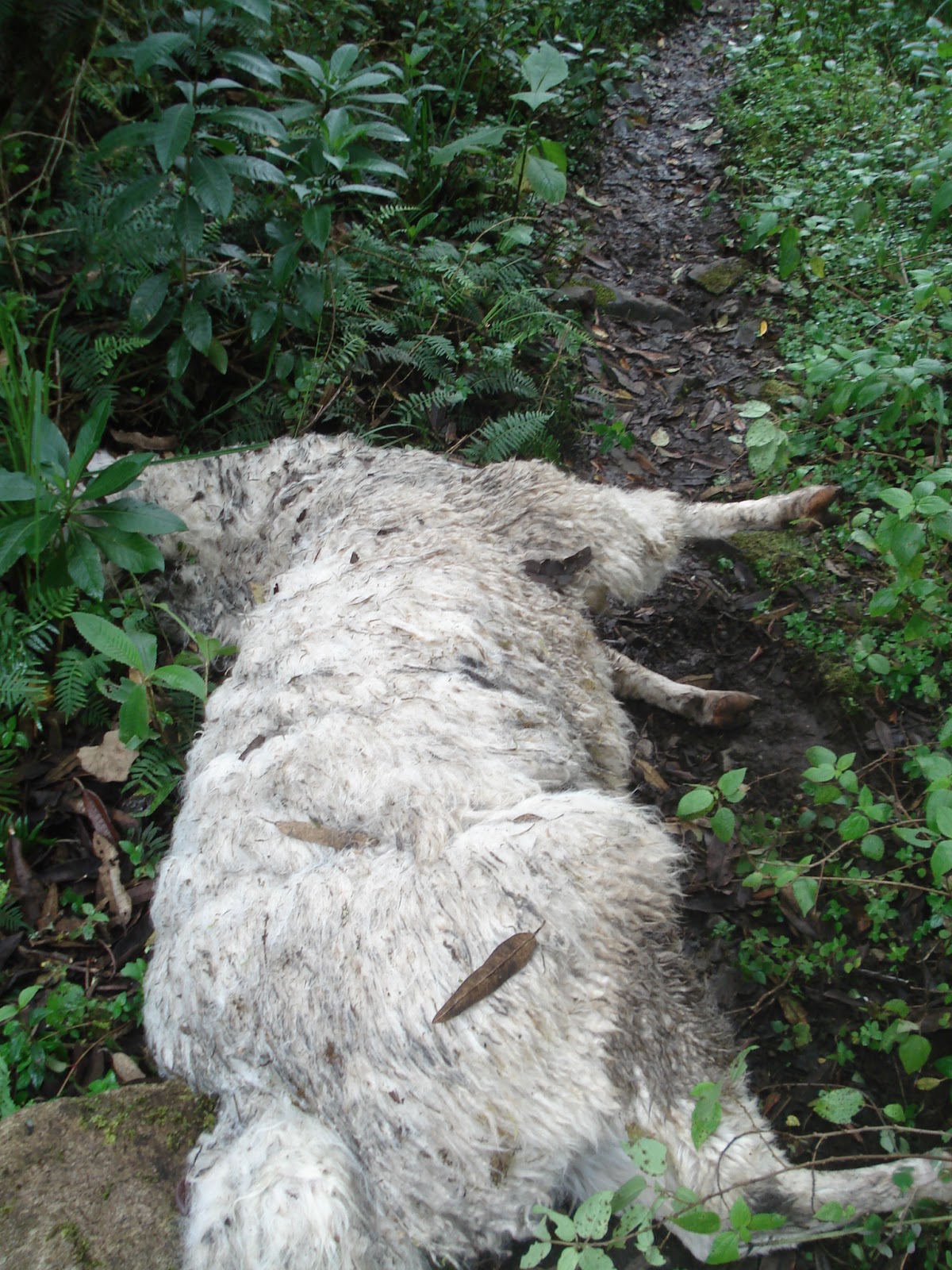
Today, we had a flight to catch at 2:20.   We were still about 6 miles from the main road, and we didn't know just how long it would take to get there or back to Cuenca.  We got up and left as soon as it was light enough to see.  In the first minutes of our hike we were slowed down by a thick, Polylepis forest.  We had to duck and crawl over trees and avoid huge areas of deep mud, all with packs on.  At this pace, we'd never make it.  Once we got out of the forest, the trail climbed up another pass, but then descended rapidly.  The mud never let up, and sections of the trail were so steep, we pretty much were rock climbing down the rail.  I was getting stressed that we weren't going to get back in time.  We finally got to the bottom of the steep section and it was a little easier going.  The trail opened up to a beautiful green field, and we were greeted buy a lone, white llama.  It was odd that the llama just sat there and didn't move when we got closer, but then we saw why.  Its mate was dead on the trail and he/she was mourning  Not sure how it died, but it was blocking the trail and we had no choice but to step over a stiff llama.  The end of the trail was in sight and we still had plenty of time.  We reached the Llaviucu check point and the guard asked to see our entrance tickets.  He was a little annoyed that we didn't register before we entered, but we just paid him the camping fee and left.  We got to the main road at around 11:00 am and started flagging down any car that looked big enough to take us and our packs back to Cuenca.  After a few tries, a guy in a SUV stopped and took us all the way back to our hotel.  Everything worked out and we made our flight.  I think in total we hiked about 15 miles.  Cajas was an amazing place, and I could have easily spent a week or more out there.  Here's some links I used to plan the hike.  It's maps and trail descriptions.   http://www.parque-nacional-cajas.org/
http://www.etapa.net.ec/PNC/bib_PNC_doc/BibliotecaDescargas/MapaCajas/mapa-tiro-web.jpg
             
Interesting Fact:  I think every culture has its own mythical hangover cure.  In the United States, it was to eat fatty foods like bacon and fried stuff.  Surprising.  The word for hangover in Ecuador is chuchaqui (choo-cha-key) and their cure for it is seafood.  Typically it comes in the form of cerviche, which is cold shrimp, fish, mussels, or a mixture, marinated in lime juice, onions, and tomato.  I heard people say that a cerviche without a beer is not a true cerviche, so I think it's the fact that you have to drink beer with your cerviche that eases the hangover.


Josh on the continental divide


The small rock in the middle is where we would sleep
First night in the cave

Lots of strange plants


Second night's cave,  Josh slept where he's standing

I slept here

We had to get down to the valley behind me

Trudging through the mud and forest.

The llama

The dead llama

Final part

Weird abandoned buildings

Heading out

Friday, September 13, 2013

Josh Comes to Ecuador

Josh at the equator monument
One of my best friends, Josh, came down to visit us for two weeks.
Here's what we did.

Josh arrived Saturday night, so all we could really do was get something to eat.  We went to a small hot dog stand called Los Hot Dogs de la Gonzales Suarez.  It's a very popular place that serves hot dogs with onions, tomato, mustard/mayo/ketchup, and crushed Ruffles potato chips on top.  Pineapple jelly is optional, but recommended.  We actually always got the Doble, which is the same thing but with two hot dogs in one bun.  Ecuadorians are very innovative with their hot dogs.  We ended up eating here several times during Josh's visit.
The "real" equator at Intiñan museum

Equator according to me
The next day we toured Quito.  We took the buses out to the equator to get some obligatory photos.  There's two equator museums.  There's one with the tall monument and then a short walk north is the "real" equator.  I guess the first one is off by a few hundred meters.  My GPS showed that the equator is still a few hundred feet north of the real one, in some random driveway. Who knows where it really is? We both liked the real equator museum better than the one with the monument.  We then met Amber in the Old Town/El Centro area of Quito and walked around the colonial streets.  It was Sunday, so not much going on, but it's still a nice place to walk around.  While on La Ronda street, we stopped in and got a giant empanada de viento.  It's kind of like an elephant ear but without cinnamon and stuffed with a little cheese.  Pretty tired, we went back to our place and relaxed.  I think we went back for more hot dogs that night.
Our massive empanada


The next morning we made our way to Baños.  We got there in the afternoon, got our hotel, and then just wandered around the city for the rest of the day.  Baños is pretty dead on a Monday.


On Tuesday, our goal was to rent some bikes and ride down the highway toward the city of Puyo.  We got some functioning bikes for 5 dollars a day and took off.  This is a popular ride, because it passes by many beautiful waterfalls and follows the river to the beginning of the Amazon rain forest.  We took our time and made many stops to look at the beautiful views.  There's zip-lines and bungee jumping along the way, but we didn't care to do any of that.  We did take a cable car that went right over one of the larger waterfalls.  We thought we could reach Puyo, but our late start and many stops left us about 10 miles short.  No big deal.  Not wanting to ride into the night, we flagged down a bus and took it back to Baños.  After returning the bikes we went to one of the public hot springs that Baños is famous for.  It was pretty crowded, but beautifully situated next to a tall waterfall.

The beginning of the rain forest
A random stream we climbed up
On the cable car
Today was a day of bus rides.  We needed to get to Cuenca from Baños, and that can take a while sometimes.  There's no direct bus to Cuenca, so we had to get one to Riobamba and then transfer.  We got up early to catch the 7:15 bus to Riobamba. We arrived at the bus station in Baños around 7, and a worker asked where we were going.  We said Riobamba, he motioned to follow him, and he took off in a dead sprint across the parking lot to the highway.  I guess the 6:45 bus was running late and we could still catch it as it was rolling away.  Caught the bus, and made it to Riobamba by 8:30.  Our bus to Cuenca left at 9:45, so we went across the street for some breakfast.  They had one of my favorites, Seco de Chivo, and we both ordered that.  It's goat stew with a huge pile of rice and some potatoes.  It was delicious.  Our bus ride to Cuenca was uneventful, but the views are spectacular.  Typical of Ecuadorian bus rides, they played a very violent movie to keep us occupied.   The death toll was in the hundreds.  We arrived at Cuenca in good time, around 3:30 pm.  We picked a hostel named Hostel Tourist del Mundo.  It was only $7 a night and had a nice view of the river.  The rest of the day was spent wandering the city.
Josh in the quinoa fields

Standing on the ruins
On Thursday we woke up and went to my favorite breakfast spot in the market (see our previous post about Cuenca).  We didn't really have anything planned for today except roam Cuenca.  We checked out the Incan  ruins, Pumapungo, and then walked across the valley to the Rio Yununcay.  We wandered around some more, but went to bed early to rest up for our big hike.

Rio Yununcay


 This one is going long, and the hike might be better as a separate post.

Interesting fact:  Everyone in Ecuador is crazy.  Not really, but a common nickname people have for each other is Loco.  Kind of like how we say Dude.  I often hear people answer their phone like, "Alo, Loco" or "Que fue, Loco?"


Friday, August 23, 2013

Volcano Spotting

Breaking the chronological order with this one since we did this a couple weeks before whale watching, but it was a neat experience and not one I wanted to leave out.

About 4 hours south by bus is an active volcano named Tungurahua.  I (Johnny) actually have seen this one have a pretty massive eruption before, but that was 50 miles away from the top of Antisana.  Since then, I've wanted to see it erupting up close.  I almost daily check the Ecuadorian geological website to view its current activity.  Normally it does nothing, but every few months it spits out ash and rock for a couple of weeks.  Once I saw that it was erupting again, I dragged Amber down to Baños so I could hike up and hopefully see and hear it erupting.
Where I sat 


We got to Baños at about 12 noon Saturday and settled into a quiet, cheap hotel.  I told Amber my plans of hiking up the large hill behind Baños so I could away from the city noise and get a little bit closer to the volcano.  She told me "have fun" and stayed behind.  I hiked up the trail to the Virgin statue that overlooks Baños and then continued up the hill from there until it leveled out.  I reached a sunny cow pasture which was quiet and had a good viewpoint of the volcano.  Then I sat and waited for the clouds to clear.  I could hear distant thundering from the volcano and could see a little bit of ash in the sky.  Finally, for a glorious 45 minutes, the clouds cleared out and I could see the whole thing.  What I could see was intermittent plumes of ash and steam.  When a new plume would rise, it was preceded by rocks the size of microwave ovens flying high into the air and crashing down on the side of the mountain.  I tried counting the time the rocks spent flying thought the air and some were as long as 20 seconds.  It was a very good show.  When I could hear the eruptions, they either sounded like whooshing air or a low deep rumble.  Then the clouds came back and the sun was setting, so I ran back down to Amber to show her my pictures.  I was really happy to be so lucky with the weather and clouds.  

The next day Amber and I walked around Baños and near the river.   We saw people jumping off a bridge with just two climbing ropes and a harness for protection.  No thanks.  

Bridge people were jumping off
Interesting Fact:  There are fast food restaurants in Ecuador, but they are a little different than back home.  The menus are the same with some exceptions like getting rice and lentils with your original recipe KFC, or guacamole and queso fresco on a McDonalds hamburger.  However, the cultural influence of fast food is different.  This is because the prices at McDonalds/KFC/Burger King here are pretty much the same as they are in the States.  In the States, one reason fast food is so popular is because it's so cheap.  But here, when you have a choice of spending 2 dollars on one hamburger, or spending 2 dollars on a big bowl of soup, large portion of rice and meat, juice, and dessert, the hamburger seems like a ripoff.  Usually the soup and rice dish is served faster than anything at KFC too.  I see McDonalds here more comparable to a place like Applebee's back home.  Most people couldn't afford to eat there everyday, but it's nice to treat yourself to it every now and then.   That being said, even though fast food is not as popular, there's certainly no shortage of overweight Ecuadorians.  

Saturday, August 3, 2013

Ocean Adventure: We spotted a WHALE

John in Puerto Lopez
        Each year between the months of June and September (but especially in July and August) humpback whales make their annual migration and chill out by the coast of Ecuador so that they can breed in warmer waters. Disappointed by the fact that we did not make it to the coast last year to witness this, John and I made a promise to ourselves that we would see the whales this year. We had no idea if we would even see a whale but we took the chance anyway. 


    Our adventure started with an overnight bus (company: Carlos A. Aray - $12 pp) out to the coastal town of Puerto Lopez. We left around 5:30 that night and arrived at an awesome 5:15 AM. The bus stopped a whole lot during the night and each time the lights turned on inside the bus. Needless to say we did not get a great night sleep. At one point John said that he woke up to a cockroach crawling on his coat. Nasty.  To top all that off, I almost lost the binoculars and our headlamp. Apparently while I was half asleep I opened the backpack to look for something and then did not zip it back up. This allowed for everything to spill out over the bus floor. Thank goodness I discovered the missing things before we arrived at the destination and we did not end up losing anything (although, our headlamp had already made it into the backpack of a fellow bus rider... I am glad he gave it back). 

Watching the fishermen on the beach
    So there we were on the side of the road (no bus station to wait in) at 5:15 AM in a dark and still very much asleep coastal town.  Did I mention that it was raining? Well, it was sprinkling on and off. We decided to wait to walk to the beach until the sun came up and parked ourselves on some stairs of a building and out of the rain. Not too long after we sat down a dog with a bandanna came over and decided that we were all going to be friends. He was super nice and actually barked at other people when they came close to us. I guess he figured that we were going to feed him or something...right. Finally the rain started to lighten and the sun started to brighten the sky. We walked with our new dog friend down the two blocks of dirt/sand road to the beach. We saw all the fishermen getting ready for the day and coming in with their fish and what not. I liked all of the birds that were circling around.  
On the whale boat
     After the fishermen watching we decided to get some bread. The province of Manabi has really really good bread. We got soft, straight out of the oven rolls for 10 cents each.  This bread is like nothing else in Ecuador. It is so good and addictive. We had to cut ourselves off at three pieces each. Mind you, these pieces are about the size of Johnny's fist, so they are not tiny. We then made our way out to the pier to watch the boats and relax since we were still tired from the bus ride. 
First whale sighting: the calm ones

  Now the fun part. We scheduled a Whale Watching tour for 10:30 am.  For $25 a person you get: 3 hours in a boat (whale watching and some snorkeling), a snack (small sandwich, banana and cup of pop) and that is about it. We actually got the tour for $22.50 each : ) Our group of fellow whale watchers had about 28 people in it. We met at the tour company and made our way to the boat. The boat took us about 10 minutes away from the shore and BAM! there was our first whale. The first whales that we saw were calm and only came up for air every 10 minutes or so. They were super graceful and so huge. At one point they were only about 15 feet away from the boat. It was amazing to see them so close. It kind of freaked me out to know that they were swimming underneath us. Eventually those whales got bored with us and we moved on to another location. Here we saw the active whales. These whales were playful, jumping up and out of the water, waving their huge arms, and smacking their giants tails on the water. It was so amazing to watch them play around and have a good time. After they had calmed down we went to a more shallow spot so that some people could snorkel. Neither John nor I participated because it was freezing out (no sun) and the water was freezing. Also, we did not have towels. On the way back to the docks we were handed our small snacks. 
Second whale sighting: the active ones.
This was the money shot I was hoping for.

             We got bus tickets home for that night (company: Reina del Camino - $13 pp) since we had seen the whales and didn't feel like staying over just to leave in the morning. To fill up the time in between the whales and the bus we walked along the beach, John took a nap on the beach, we ate lunch (I had a really good ceviche and John had fresh fish) and of course we bought more bread. The bus ride home was much more pleasant. They bus was so new and clean and the seats reclined almost all the way.  The only down side to the bus was that it was super fast and landed us back in Quito around 4:15 AM.  We decided to wait in the bus station until we could take a bus home because the taxis were being ridiculous with their prices. At 6:15 we caught the local bus home and we were warm and safe by 7:15 AM in Guapulo. 

As always, there are more pictures of this trip on my Facebook page : )

Interesting fact: The whales the migrate to the coast of Ecuador are mostly from the Southern Hemisphere  coming up from the Antarctic. They come to breed in the warmer waters because their calves are born with a thin insulating layer and they cannot survive in the cold waters of the south just yet. These baby humpbacks will eventually grow up to be 12-15 meters in length (40 - 50 feet) and weight up to 30 tons.  It is believed that humpback whales are the most acrobatic of the large whales (note the money shot above).


Monday, June 10, 2013

More Mountains


Top of Rumiñahui


For three weekends in a row, I went climbing.  There were two mountains left that I wanted to go to for a long time, and the third was just a bonus.

The first one was the south peak of Rumiñahui.  I've already been to Rumiñahui, but I went to the north peak.  Rumiñahui was one of my favorites.  My neighbor went to the south and showed me pictures, and I got jealous.  The south peak is lower, but it's a bit more complicated and requires more rock climbing.  9 of us went and we all made it to the top.  Like most of the volcanoes in Ecuador, the rock was really loose and crumbly.  We had to rappel down a steep, crumbly section, because it was too dangerous to just climb down.  While here, I found a morel mushroom at around 13,000 ft.  We also saw three condor nest in the side of the cliff, but no condors.

Sincholagua
Top of Sincholagua
The next weekend was Sincholagua.  The is a big fat mountain next to the large snow-capped Cotopaxi.  I saw this one about a year ago, and have wanted to go to it since.  We had to leave at 4 in the morning, because it was going to be a long hike.  Our little bus got stuck in the wet grass, so we started from where it got stuck.  Sincholagua became my new favorite snowless mountain in Ecuador.  We had great weather and even better views.  At the tiny summit, there's a drop off that goes down hundreds of feet.  We all had to walk very carefully.

Steep section on Cotocachi
Top of Cotocachi


The final mountain was Cotacachi.  This is pretty much the last one on my list of easily accessible Ecuadorian mountains.  I would still like to go to Iliniza Sur, but I'll have to do some convincing to Amber.  Cotacachi is almost always in the clouds.  I've only seen the whole mountain a few times from Quito.  For this one, we traveled north, back home into the Northern Hemisphere.  I had heard this was a somewhat challenging climb, with lots of rock climbing parts,  but I didn't know exactly what I was in for.  This day, like most, the mountain was cloudy and very windy.  Once we got to the steep section, we put on our harnesses and started scrambling on really loose rocks.  At one point, there was a 60 ft steep wall section with an endless drop at the bottom.  Because it was cloudy, we really couldn't see how far it went down.  It was just an abyss.  The guide set up a fixed rope up the wall, but we weren't attached to it.  It was just there in case we fell, we might have a chance of grabbing it.  Almost every rock we stepped on could be pulled out with enough force.  Many didn't need any effort at all to come out.  Putting all my weight on one rock felt like playing Russian Roulette.  We finally made it up the wall and up some more steep parts, dodging rocks that people above me were kicking loose, and to the top.   It was cold and windy, so we only stayed for a little bit.  The way back down was more nerve wracking, because now the clouds had gotten denser and all the rocks were wet and slippery.  Very slowly, we got back to safer ground.  I was pretty tired after this, but not physically, more like when you drive in a bad snowstorm for 5 hours, thinking you're going to crash the whole time.  We road in the back of a truck to get back to the bus, and I was a little sad that it might be my last time going with this climbing group.  We'll see.  

Interesting fact:  Many Ecuadorian cities/towns are known for a specific specialty, often food.  For example, Salcedo is known for it's multi-layered fruit flavored ice cream, Cayambe is known for Biscochos (dry biscuits), Gayallabamba is Cherimoya and avacado town, Latacunga has the Chuchucara, Montecristi is Panama hats.  I know there's more, but these are the only ones I can remember right now.

Friday, May 10, 2013

Market Days

We've been staying in Quito the past few weekend, which means we have time to go to the market and buy food for the week.  In our effort to spend as little as possible on food, we've scouted out and found what we think are the cheapest places to buy things.

There's a few different options in Quito for getting groceries.  One option is the tiendas.  All around Ecuador are little shops that all sell pretty much the same thing.  They have snack foods, dry goods, and basic fruits and vegetables.  One of our neighbors said they have survived off the tienda near our house for a month or so.  Because of the limited options, and often high produce prices, we don't go to tiendas for weekly groceries.    

Another option is a supermarket, specifically SuperMaxi.  I hate SuperMaxi.  Shopping here is as miserable experience as shopping at Wal-Mart or Target, and like Target, SuperMaxi stinks.  However not of dirty carpet, stale popcorn, and sweatpants but more sour, like someone spilled a jar of olives and never cleaned it up.  The stench seems to emanate out of the deli section.  We tried to go 3 months without shopping at SuperMaxi to see if it could be done.  It can, but like Wal-Mart, they really do have the lowest prices on certain things.  So we now go to SuperMaxi only for some basic items like milk, sugar, juice packets, and oatmeal.   We never get produce from SuperMaxi because it's expensive and not ripe.  There also is MegaMaxi, which is twice as big and twice as awful.  It's like a Wal-Mart Supercenter.  There's electronics and furniture and crap, in addition to food.

The other option is the indoor/outdoor food markets.  There are many of these scattered around Quito and Ecuador.  They sell lots of different  fruits, vegetables, meat (we never buy meat), and dry goods.  Some are open every day and some only once a week.  There's even just covered trucks filled with produce that stop near our house once a week and sell from their truck.  All these places sell the same thing, but they don't charge the same.  Often, if the market is in a building, it's going to be a little more expensive.  Two markets near the center of Quito named Iñaquito and Santa Clara are nice indoor markets, but we never shop there because we know where to find cheaper prices.  One exception to the indoor rule is a market in southern Quito named  San Roque.  It's cheap but smelly and dirty.  Also, when we told some Ecuadorians we were going there, they all said that it's dangerous and there's robbers everywhere.   We were fine, but I doubt we'll be going back.

This doesn't show the whole market.  This will be and empty lot on Sunday
So where do we go for the lowest prices and nicest shopping experience?  Only to the market that's farthest away from our house.  It takes a 25 minute, hilly to walk to then catch a  40 minute bus to our market, but it's worth the effort.  It's located in the north of the city in an area called Cotocollao, near the Ofelia bus station.  It's a huge open-air market where good deals on food can be found.  For example, we got 15 small avocados for a dollar last week. We also just like the atmosphere at this market.  This is how we spend most Saturday mornings when we're not traveling.  Going to the market is one part of living in Quito we really enjoy.        
Here's the other half.


The meat isle
Most things in piles sell for a dollar


Avocado ally

It gets busier the later it gets

Fish stand

Bags of rice, beans, corn and flour on the left

Interesting Fact:  We all know of Orson Wells' broadcast of War of the Worlds and the panic is caused in the US, but Quito did panic one better.  In 1949, a Spanish version was broadcast in Quito and it caused police, fire officials and citizens to rush out and fight the aliens.  Once the people realized they were fooled, they then rushed the radio station and local newspaper and set it ablaze. 6 people were killed in the War of the World Riots in Quito.

Sunday, April 21, 2013

You're going to Quevedo? Why?

Laguna Quicocha
That's what every person we told asked us when we told them what we were doing that weekend.  More on Quevedo in a bit.

On the long Easter weekend, we took advantage of our time off to see a few more places we haven't been to.  Thursday, we got up early and took the bus from the Carcelen station in Quito to Otavalo.  From Otavalo's station we hopped on a bus going to Quiroga for 25 cents and paid 5 dollars for a ride in the back of a pickup truck to our destination Lagua Quicocha.  Lagua Quicocha is another crater lake, like Quilatoa, but this one has two islands in the middle that are supposed to look like guinea pigs.  Quicocha is the Quitchwa word for guinea pig.

Our goal was to hike around the crater rim. It was a pretty easy hike with nice views of the lake and nearby Cotacachi mountain (which I hope to climb in May).  The last hour though wasn't on a trail but a dusty road.  When we got back to the park entrance we continued walking down the long road toward town, hoping to catch a ride from someone.  It took a while, but eventually a taxi drove by and took us back to Quiroga, and we went back to Quito.

We're still trying to do something in each of the 24 provinces of Ecuador, so to knock out Los Rios and Santo Domingo province we planned to spend Friday night in the city Quevedo, and catch breakfast in Santo Domingo.  These two cities have little to offer for tourists.  When we told our coworkers we were going there, they couldn't understand why.  It would be like a foreigner in the US saying they were going to go visit Youngstown, Ohio, or Gary, Indiana.

Amber grinding grain in Quicocha
Quevedo is known for having a high number of Chinese immigrants and Chinese restaurants so our goal here was to eat some Chinese food.  We were in the main part of town and only saw 2 restaurants and 2 Chinese people.  However, the food we got was really good.  The hotel we chose was memorable but not really in a good way.  We just picked a hotel and asked the guy how much.  I didn't understand a word he said, because they have a different accent and speak very quickly in western Ecuador.  I finally figured out that the room was only $12 for both of us.  He showed us one room where the toilet was actually in the shower.  So you could sit down and do your business while having water spayed on you.  I guess that's convenient.  I noticed a room in the back that had no windows and was farther away from the street.  Amber sleeps better with no light and noise from the street so I asked if we could have that room.  This whole time, the hotel guy had been carrying two buckets of water with him.  It wasn't until he dropped them off in the bathroom when I understood what he had been trying to tell me in the beginning.  There's no running water.  Whatever.  We're only there for night.  At least it has A/C.  Sort of.  The window style air conditioning unit was installed with the back part in the bathroom.  No windows, so this was their only option.  Essentially it was as effective as just putting the thing on a table in the room.  Our room cooled off a bit, but the bathroom was 100 degrees or more.  We kept the bathroom door open because we were afraid of it getting too hot.

After a sweaty night's sleep on plastic sheet, we walked to the bus terminal and caught a bus going to Santo Domingo.  The view on the ride was full of banana and chocolate tree plantations.  Some guy got on the bus selling hot Piña bread, so we bought one.  It was okay.  Santo Domingo was another rundown city with abandoned factories and houses.  Not much to see there.  At the bus terminal, we wandered around a bit and bought a popular drink that's made in Santo Domingo called Avena Polaca.  It's a cold, milk-based drink thickened with powdered oatmeal.  It's like drinking a melted vanilla milkshake and Amber and I both love them.  Then I got an over-priced and not very good seco de pollo with rice for breakfast.  We caught a bus back to Quito and rested the rest of the weekend.

Interesting Fact:  A mild curse word they use in Ecuador fairly often is Miércoles!  If you know your Spanish then you know it means Wednesday.  So imagine stubbing your foot on the bed, shaking your fist in air, and shouting, "Oh, Wednesday!!"